村上由美子——日本の「猶予」に年数をつけた投資家
国連、ゴールドマン・サックス、OECD東京センター、そして日本初のESG特化型グローバルVC。村上由美子氏の「5年」は警告ではなく、資金配分の判断である。
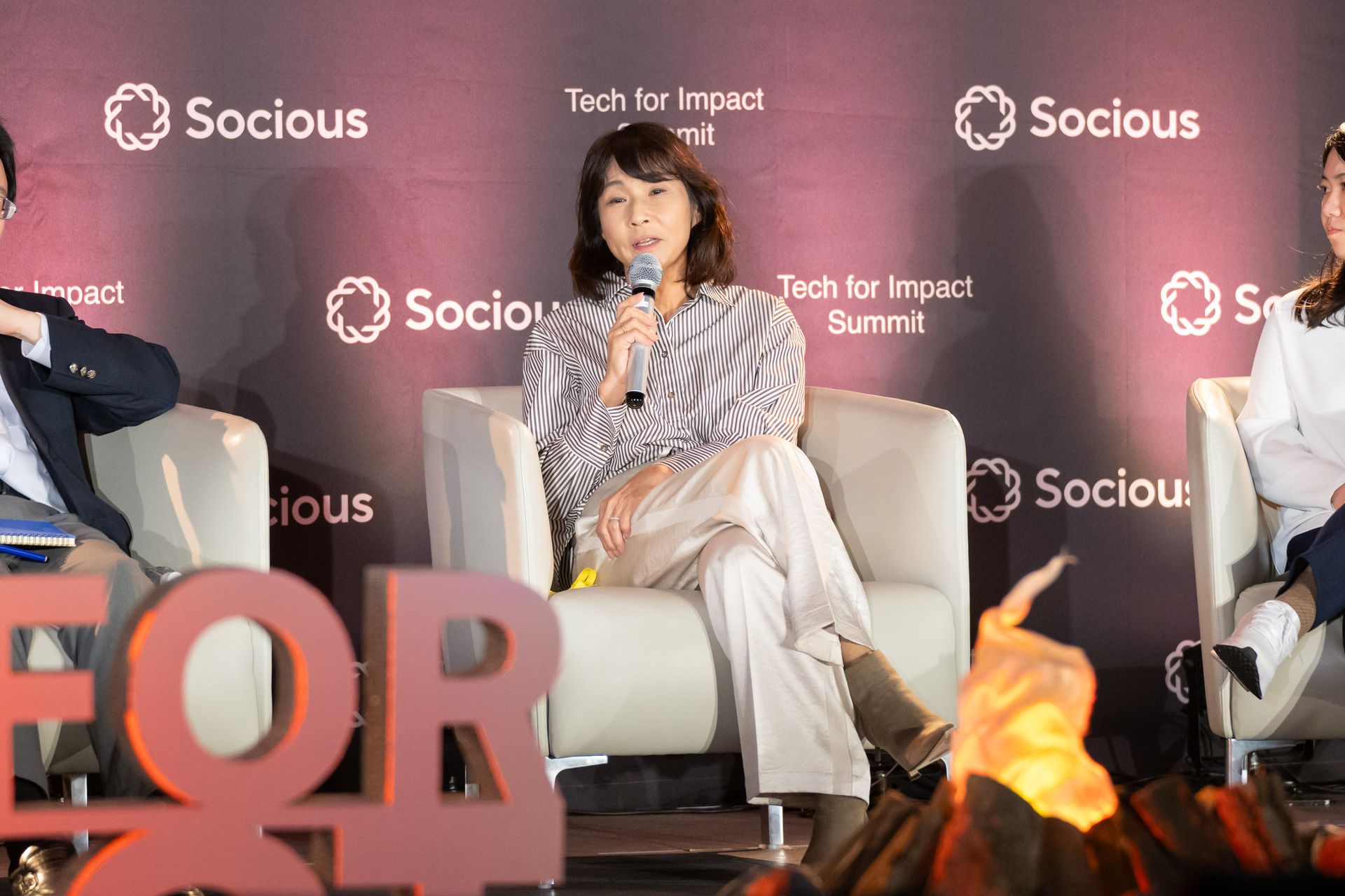
Most people who talk about Japan and AI say ahead or behind. On the Tech for Impact Summit 2026 fireside stage, Yumiko Murakami gave a number of years.
“Given the very limited time and given the advantage that they have, they’re really trying to move very quickly. It could be just five years. It could be just ten years. It could be two years, depending on how quickly these technologies develop.”
Murakami runs a fund. Her number has money behind it.
Four careers, one recurring question
Murakami’s route to venture capital passed through three institutions that rarely appear on the same CV.
She began at the United Nations, working in Barbados, Cambodia and New York. She then spent close to twenty years in investment banking, most of it as a managing director at Goldman Sachs across New York, London and Tokyo. She left markets for policy, running the OECD Tokyo Centre for seven years, where the work was economic policy development with Japanese government entities. She holds a BA from Sophia University, an MA from Stanford and an MBA from Harvard Business School, and she has served on Japanese government advisory panels, including the prime minister’s panel on the New Form of Capitalism (MPower Partners).
In each of those jobs she has worked on the same problem: how to get capital to go where markets price badly.
The fund that did not exist in Japan
In May 2021, Murakami launched MPower Partners Fund L.P. with Kathy Matsui and Miwa Seki. The launch announcement described it as a type of fund Japan’s VC industry did not have until then, with ESG built into the investment process instead of applied as a screen. It gave target capital commitments of US$150 million and initial limited partners including Dai-ichi Life Insurance, Sompo Holdings and Sumitomo Mitsui Trust Group. The mandate was growth- to late-stage Japanese startups, with the remainder into earlier-stage companies overseas, across healthcare and wellness, fintech, the next generation of work and education, consumer, and sustainability (MPower Partners).
Four years on, the firm announced Fund II in May 2025, with the Japan Investment Corporation joining as a new investor. Fund II keeps the original theme of solving societal challenges with technology and adds a second one, “Japan Dynamism”: startups that strengthen national resilience and long-run growth capacity (MPower Partners). The fund size was not disclosed.
Keep that second theme in mind when reading her T4IS remarks. The resilience she talks about is what her fund invests in.
What she argued at T4IS 2026
Murakami appeared on the Learning in the Age of AI panel alongside Satoshi Hirose, Dean of GLOBIS University’s Graduate School of Management, and Maiko Kojima, founder and CEO of the enterprise AI company Crafter, moderated by Harry Dempsey of the Financial Times. The full recap is here. Three parts of her argument stand out.
The starting point is population. Japan’s light-touch AI policy, she argued, comes from the headcount numbers.
“Japan is facing the reality and really embracing the reality that we don’t have people. We are rapidly shrinking. They are actually trying to embrace AI in the classroom in a very constructive manner. They’re starting with elementary school, which I think is great. That’s what’s needed because we don’t have a lot of people. So you have to start with the younger generation.”
The gap is in asking questions. Murakami worked with OECD assessment data at the Tokyo Centre. Japanese fifteen-year-olds rank at the top internationally in numeracy and literacy, and every public school student has had a personal device since 2020 or 2021. What she sees missing comes after that.
“In the era of AI adaptation, that’s the ability — that’s the number one priority in terms of where education needs to focus on. Critical thinking. Can you think outside the box? There are many questions in the real world where there are no obvious right answers. And sometimes there is no answer.”
Rigid labour practice buys time. In Japan it is slow and costly to cut headcount when a new technology arrives. Murakami reads that as a window.
“It gives companies a little bit of a breathing space. It gives people the time to think about what they should do — not to replace people, but to retrain, reskill, and upskill.”
So she says her interest is the AI-utilization layer, not the model layer. Japanese companies can buy access to frontier models. Fewer of them have the internal machinery to put that access to work.
The number that tests the thesis
On the same panel, Kojima gave the counter-evidence. Citing NTT Docomo’s most recent enterprise survey, she put Japanese corporate AI adoption at 50–60%, up from roughly 20% two years earlier. Then she described what that number hides.
“They adopted AI, but not so many people, not so many employees are using their own AI. If they use it, it’s almost like very limited use cases.”
Buying a tool is a procurement decision. Using it every day is an operating change. Murakami’s window is the time Japanese companies have to get from the first to the second.
Her argument can be checked. If Japanese firms spend the breathing room on retraining and workflow redesign, the shrinking workforce turns into a head start, and the companies building that layer do well. If they spend it waiting, the same labour rules that bought the time will keep the old workflows in place until the time is gone.
A board can check this inside its own company. Count how many staff use an AI tool in a task they are accountable for, and count which processes were redesigned. The number of tools bought last year says little.
Why this belongs on the 2027 agenda
Tech for Impact Summit brings together leaders from business, policy and culture around technology aimed at urgent problems. Murakami has worked the same question from the UN, from Goldman Sachs and from the OECD, and now invests against it. When she says the window might be two years, that is an assumption inside a fund’s investment decisions.
The 2027 gathering takes place on 18–19 May 2027 in Tokyo. The questions Murakami raised, where the retraining layer gets built, who pays for it, and what happens to companies that treat AI as a purchase, are on the agenda. You can see who has taken the stage on the speakers page.
Attendance is by invitation. If you lead an organisation working at the intersection of technology and impact and would like to be considered for 2027, you can register your interest — we review every submission personally.
Learn more at tech4impactsummit.com.
Sources: MPower Partners (team biography, Fund I launch announcement of 31 May 2021, Fund II announcement of 14 May 2025); Tech for Impact Summit 2026 session recording, via our published Learning in the Age of AI panel recap (all quotations); Tech for Impact Summit speaker roster (current role and biography).